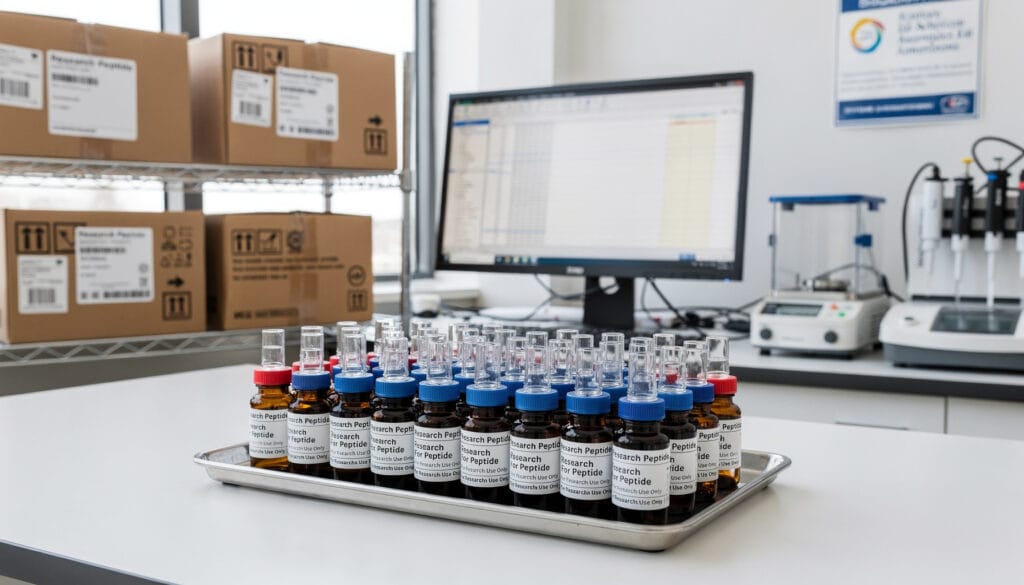
Understanding Bulk Research Peptides and What Sourcing Them in the US Entails
Bulk research peptides are laboratory-grade peptides manufactured in larger quantities to support extensive experimental studies and complex research projects at institutions, universities, and contract research organizations (CROs) throughout the United States. These peptides are synthesized through highly controlled and precise chemical peptide synthesis processes, typically solid-phase peptide synthesis (SPPS), which allows for the production of specific amino acid sequences with a high degree of accuracy and reproducibility.
Below, we explain how to source bulk research peptides in the United States — how to evaluate a bulk peptide supplier, which documentation to demand with every batch, and how to place bulk peptide orders with confidence for laboratory research.
The process of sourcing bulk research peptides in the US involves more than just placing an order. It requires a thorough understanding of the quality assurance measures that underpin peptide production and distribution. Reputable suppliers provide detailed documentation such as Certificates of Analysis (COAs), which confirm peptide purity and identity through validated analytical techniques including High-Performance Liquid Chromatography (HPLC) and mass spectrometry. These documents are critical for verifying that the peptides meet stringent research-grade specifications and are fit for laboratory use only, avoiding any ambiguity regarding their intended application.
Certificates of Analysis typically include multiple key data fields that provide comprehensive insight into peptide quality. Important COA fields include the peptide name, batch or lot number, molecular weight, sequence confirmation, peptide purity percentage, and testing dates. The molecular weight listed is compared against theoretical calculations to confirm correct synthesis, while the batch number facilitates traceability. Additionally, the COA often includes chromatograms from HPLC analysis, which depict the separation of the peptide from impurities, and mass spectra that verify molecular identity and sequence integrity.
HPLC purity percentages, commonly expressed as area-under-the-curve (AUC) values, indicate the proportion of the main peptide peak relative to all detected peaks in the chromatogram. A purity above 95% is generally considered acceptable for most research applications, though certain specialized studies may require higher purity. The chromatogram also reveals the presence of any side products, truncated sequences, or degradation compounds, enabling researchers to assess sample suitability.
Mass spectrometry analysis, such as Matrix-Assisted Laser Desorption/Ionization Time-of-Flight (MALDI-TOF) or Electrospray Ionization (ESI-MS), provides precise molecular weight data and can confirm sequence fidelity by detecting expected mass/charge (m/z) ratios. The presence of a dominant peak matching the theoretical molecular weight and absence of significant byproducts indicates successful synthesis and purification.
In addition, US-based sourcing offers advantages in terms of supply chain transparency, manufacturing oversight, and compliance with domestic regulatory frameworks that govern research materials. Traceability from raw material sourcing through synthesis, purification, and packaging ensures that each batch of peptides can be reliably tracked and audited, which is essential for reproducibility in scientific investigations. Laboratories must also ensure that peptides are clearly labeled as research-use-only to comply with federal guidelines and prevent misuse.
To maintain peptide integrity, proper handling and storage are critical. Bulk peptides should be stored as recommended by suppliers, typically at -20°C or lower in lyophilized form to prevent degradation. Once reconstituted, peptides often require storage at 4°C for short-term use or at -80°C for long-term preservation. Minimizing freeze-thaw cycles and exposure to moisture or light helps maintain peptide stability, ensuring consistent experimental results.
Overall, sourcing bulk research peptides domestically in the US demands collaboration with suppliers who prioritize rigorous quality control, comprehensive documentation, and transparent communication, thereby supporting the integrity and reproducibility of research activities.
Why Research Labs Buy Peptides in Bulk
Research laboratories opt to purchase wholesale research peptides in bulk quantities for numerous practical and scientific reasons, each contributing to the efficiency and rigor of their work:
- Cost Efficiency: Procuring peptides in bulk significantly reduces the cost per milligram, which is vital for labs engaged in extensive or longitudinal studies requiring repeated or large-scale use of peptides. Bulk purchasing allows labs to better allocate their budgets while maintaining access to high-quality reagents. This cost saving stems from reduced per-unit manufacturing overhead, minimized packaging costs, and streamlined shipping logistics. Additionally, bulk orders often reduce administrative costs associated with frequent reordering, invoicing, and inventory management.
- Supply Continuity: Consistent peptide availability is crucial to prevent interruptions in research workflows. Bulk ordering reduces the risk of delays caused by production lead times or stock shortages. It also safeguards against variability due to sourcing peptides from different suppliers or different production runs, which can introduce inconsistencies affecting experimental outcomes. Having a stable stock ensures that experiments can proceed without delay, which is particularly important for time-sensitive or multi-phase studies.
- Research Scale and Consistency: Large-scale experiments, such as those involving dose-response studies or high-throughput screening, often require peptides from the same manufacturing batch to ensure homogeneity in reagent quality. Bulk orders facilitate this consistency by providing sufficient quantities from a single batch. This uniformity supports reproducibility, minimizes batch-to-batch variation, and ensures that comparative studies are scientifically valid. Batch-to-batch consistency is verified through rigorous quality control, including comparison of COA data such as HPLC purity and mass spectrometry results, ensuring that peptides from different lots exhibit equivalent characteristics.
Furthermore, bulk purchasing supports logistical simplification by reducing the frequency of reordering and administrative overhead, allowing research teams to focus more on experimental design and data analysis. It also allows labs to implement standardized storage and handling procedures for consistent reagent management. In summary, buying peptides in bulk aligns with best practices in laboratory management by optimizing cost, supply reliability, and scientific consistency.
What to Look for in a Bulk Peptide Supplier
Choosing the right supplier for bulk research peptides is a critical decision that impacts experimental validity and operational efficiency. Researchers should evaluate suppliers based on several quality and service standards:
- Third-Party Certificate of Analysis (COA): A cornerstone of supplier credibility is the provision of a Certificate of Analysis issued by an independent, accredited laboratory. This COA verifies key quality parameters such as peptide identity, purity, and concentration. It typically includes chromatograms, mass spectra, and numeric purity values, providing transparent evidence that the peptide meets specified standards. The COA should be batch-specific and readily accessible upon request or shipment. Reputable suppliers adhere to ISO/IEC 17025-accredited testing standards to ensure accuracy and reliability of analytical data.
- High-Performance Liquid Chromatography (HPLC) Purity Percentage: HPLC is the gold standard analytical technique for assessing peptide purity. The supplier’s COA should report a purity percentage typically exceeding 95%, calculated based on the area-under-the-curve (AUC) of the main peptide peak relative to total detected peaks. Detailed HPLC chromatograms allow researchers to visualize the presence of impurities or degradation products. High purity ensures that experimental results are attributable to the peptide of interest without interference from contaminants. Researchers should also consider the HPLC method details such as column type, mobile phase composition, gradient profile, and detection wavelength, as these factors influence chromatogram interpretation.
- Mass Spectrometry Identity and Sequence Confirmation: Mass spectrometry (MS) analysis provides molecular weight confirmation and helps verify that the synthesized peptide matches the intended amino acid sequence. Techniques such as MALDI-TOF or ESI-MS are commonly employed. The supplier should provide MS data showing a dominant peak corresponding to the expected molecular weight and minimal evidence of truncated sequences or modifications. This confirmation is crucial for experiments relying on precise peptide structure-function relationships. Where applicable, fragmentation analysis (MS/MS) may be provided to further validate sequence integrity.
- Batch Traceability: Reliable suppliers maintain detailed batch records that trace each peptide lot through its production lifecycle, from raw material sourcing to synthesis, purification, and final packaging. This traceability enables quality audits, facilitates troubleshooting, and supports regulatory compliance. In addition, consistent batch-to-batch manufacturing practices ensure reproducibility, a fundamental requirement for scientific research. Many suppliers implement electronic batch record systems for secure and efficient data management, enabling traceability and recall readiness if necessary.
- Transparent Sourcing Practices: Suppliers should openly disclose their peptide synthesis methodologies, raw material origins, and quality control protocols. Transparency regarding whether peptides are synthesized using automated SPPS, purification methods (such as preparative HPLC), and analytical testing routines allows researchers to assess the robustness of the supply chain and manufacturing process. This openness also reassures customers that peptides are produced under conditions aligned with research-use-only standards. Details about raw materials, such as the source and purity of Fmoc-protected amino acids and resins, contribute to overall peptide quality assurance.
- Clear Research-Use-Only Labeling: It is essential that all peptides are labeled and documented explicitly for research use only. This labeling ensures compliance with regulatory guidelines, preventing any inadvertent use outside the scope of laboratory research. Suppliers should provide clear disclaimers and documentation to this effect to maintain ethical and legal standards. Appropriate labeling on packaging and accompanying documentation also facilitates institutional compliance with internal policies and external regulations.
- Handling and Storage Recommendations: Reputable suppliers provide detailed guidelines for peptide handling and storage to maintain quality post-delivery. Instructions typically include recommended temperature ranges for lyophilized and reconstituted peptides, protection from moisture and light, and advice on minimizing freeze-thaw cycles. Following these guidelines helps preserve peptide stability and bioactivity during storage and experimentation.
By carefully vetting suppliers against these criteria, research teams can secure peptides that support high-quality, reproducible experimental outcomes while aligning with regulatory and ethical standards.
Red Flags When Sourcing Bulk Research Peptides
Researchers must remain alert to potential warning signs that may compromise peptide quality or sourcing integrity. Common red flags include:
- Absence of a Certificate of Analysis (COA): Suppliers who cannot provide a batch-specific COA introduce uncertainty about the peptide’s purity, identity, and manufacturing history. Lack of a COA undermines traceability and quality assurance, raising the risk of introducing substandard reagents into experiments. This may result in unreliable or non-reproducible data.
- Vague or Missing Purity Data: Absence of specific HPLC purity percentages, or statements that use ambiguous terms such as “high purity” without quantitative backing, suggest insufficient quality control or deliberate obfuscation. Reliable suppliers provide detailed chromatographic data with clear purity metrics. Without precise purity data, researchers cannot accurately assess reagent suitability or compare batches.
- No Batch Records or Traceability: Without comprehensive batch documentation, it is impossible to verify production consistency or investigate anomalies. This limits the ability to ensure reproducibility or to identify the source of any experimental discrepancies linked to peptide quality. Traceability also supports compliance with institutional and funding agency standards.
- Missing Research-Use-Only Labeling: Peptides lacking explicit research-use-only labels may reflect non-compliance with regulatory standards or indicate that the supplier markets products for unapproved applications. This raises ethical and legal concerns, and such materials should be avoided. Use of peptides without proper labeling can jeopardize institutional approvals and audit outcomes.
- Unverifiable or Exaggerated Claims: Suppliers making unsupported claims about peptide efficacy, therapeutic benefits, or human-use applications are operating outside the scope of research-grade peptide provision. These claims are not only misleading but may violate regulatory restrictions. Researchers should rely solely on suppliers who adhere strictly to research-use-only designations and scientific evidence.
- Poor Customer Support or Lack of Transparency: Suppliers who are unresponsive to inquiries about quality data, manufacturing processes, or order fulfillment can impede research planning and risk supply chain disruptions. Transparent communication and knowledgeable support are critical for managing bulk orders and ensuring reagent quality.
Identifying and avoiding these red flags protects the integrity of research data and ensures compliance with institutional and federal guidelines.
How Verified Peptides Handles Bulk Research Orders
At Verified Peptides, we are dedicated to supplying research laboratories and institutions across the United States with high-quality bulk research peptides tailored to the rigorous demands of scientific investigation. Our approach combines stringent quality assurance protocols with transparent, customer-focused service to support your research goals.
- Per-Batch Certificate of Analysis: Every peptide batch we manufacture undergoes thorough analytical testing before shipment. We provide a detailed, independently verified Certificate of Analysis for each lot, encompassing essential data such as HPLC purity percentages—typically exceeding 95%—and mass spectrometry results confirming molecular weight and sequence identity. Our COAs include chromatograms and mass spectra that allow researchers to independently evaluate peptide quality. Each COA specifies the batch number, peptide sequence, molecular weight, purity, date of synthesis, and testing details to facilitate traceability and documentation.
- HPLC and Mass Spectrometry Verification: Verified Peptides employs both in-house and third-party laboratories accredited under ISO/IEC 17025 standards to perform analytical verification. Using state-of-the-art HPLC systems, we quantify peptide purity by calculating the area-under-the-curve (AUC) of the principal peak relative to impurities. Mass spectrometry analysis, including MALDI-TOF or ESI-MS techniques, confirms that the peptide’s molecular weight matches the theoretical sequence with high precision, ensuring sequence fidelity. We also provide chromatographic method parameters to aid in reproducibility and comparison with in-house analyses.
- Consistency Across Batches: We implement strict batch-to-batch control measures by maintaining consistent synthesis protocols, purification criteria, and quality testing. Our traceability system records every step of the manufacturing process, allowing us to replicate production parameters and supply peptides from the same batch for extended projects. This consistency is vital for reproducible research and robust data generation. Our electronic batch record management enables rapid retrieval of production data to address any quality inquiries or project-specific requirements.
- Clear Research-Use-Only Labeling: All peptides supplied by Verified Peptides are clearly labeled and documented for laboratory research use only. We adhere closely to regulatory standards and industry best practices to ensure that our products are not misrepresented or used outside their intended scope. Our material safety data sheets (MSDS) and product literature reiterate this designation, supporting institutional compliance. Packaging includes explicit labeling to prevent misuse and to comply with federal and institutional guidelines.
- Dedicated Customer Support: We understand that bulk peptide procurement involves careful planning and budgeting. Our knowledgeable customer service team is available to discuss your specific project requirements, including current minimum order quantities, pricing, and lead times. We work collaboratively with research teams to develop procurement strategies that maximize efficiency and ensure uninterrupted supply. Our team also assists with technical questions related to peptide specifications, handling, and storage recommendations.
- Handling and Storage Guidance: Verified Peptides provides detailed recommendations for the proper handling and storage of peptides to maintain quality. We advise customers to store lyophilized peptides at -20°C or colder, avoid repeated freeze-thaw cycles, and protect reconstituted solutions from prolonged exposure to ambient temperatures, moisture, and light. These guidelines help preserve peptide integrity and function during experimental use.
We encourage researchers, procurement officers, and laboratory managers to contact us directly to explore how Verified Peptides can provide reliable, high-purity bulk research peptides tailored to your scientific needs. By partnering with a trusted bulk research peptide supplier like Verified Peptides, your lab benefits from premium quality reagents supported by comprehensive quality documentation and attentive service—key factors in advancing your research responsibly and effectively.
Additional Considerations: Peptide Stability and Handling Best Practices
Beyond sourcing and quality assurance, understanding the stability characteristics of peptides and best practices for their handling is essential for maintaining reagent integrity throughout research workflows. Peptides are sensitive biomolecules that can undergo chemical degradation such as oxidation, hydrolysis, or aggregation if improperly stored or handled.
Lyophilized peptides stored under desiccated conditions at -20°C or below exhibit excellent long-term stability, often maintaining integrity for months or years. However, once reconstituted in aqueous or buffered solutions, peptides become more vulnerable to degradation. We recommend preparing aliquots to avoid repeated freeze-thaw cycles, which can denature peptides and reduce activity. Short-term storage of reconstituted peptides at 4°C is generally acceptable, but for extended periods, freezing at -80°C is preferred.
Peptide solubility can vary depending on sequence and modifications; suppliers often provide guidance on solvents and pH conditions optimal for dissolution. Researchers should also use low-binding tubes and avoid exposure to light and elevated temperatures during handling to minimize degradation risks. Adhering to these best practices ensures that the high purity and identity guaranteed at the point of manufacture are retained through to experimental application.
Ensuring Ethical and Regulatory Compliance in Bulk Peptide Procurement
Compliance with institutional, federal, and industry regulations is a critical aspect of sourcing bulk research peptides. Verified Peptides emphasizes adherence to all applicable guidelines, including clear research-use-only designations, to prevent unauthorized or unapproved applications. This commitment supports ethical research conduct and institutional oversight.
Researchers should verify that their peptide suppliers provide transparent documentation and labeling to facilitate compliance with internal policies and external audits. Maintaining complete records of peptide sourcing, batch information, COAs, and handling procedures supports traceability and accountability, which are increasingly scrutinized within the research community.
By selecting suppliers that prioritize regulatory compliance and ethical standards, laboratories can ensure that their procurement practices align with best practices and funding agency requirements, thereby safeguarding the integrity and reputation of their research programs.
Frequently Asked Questions
What defines bulk research peptides compared to small-scale peptide orders?
Bulk research peptides refer to larger quantity orders of peptides intended for extensive laboratory research projects, whereas small-scale orders typically serve preliminary studies or limited experiments. Bulk orders enable cost savings, supply continuity, and consistency across multiple experiments.
How can I verify the purity and identity of bulk research peptides from a supplier?
You should request a third-party Certificate of Analysis (COA) that includes High-Performance Liquid Chromatography (HPLC) purity percentages and mass spectrometry (MS) data confirming the peptide’s molecular weight and sequence. Reliable suppliers provide these documents for every batch.
Why is batch traceability important when sourcing bulk peptides?
Batch traceability allows researchers to track peptide production history, ensuring consistent quality and enabling investigation of any issues related to specific lots. It supports reproducibility and regulatory compliance in research workflows.
Are all research peptide suppliers in the US required to label products as research-use-only?
Yes, reputable suppliers label their peptides explicitly for research use only to comply with regulatory guidelines and to prevent misuse. This labeling is a critical marker of supplier transparency and ethical standards.
How do I determine the minimum order quantity and pricing for bulk research peptides?
Minimum order quantities and pricing vary depending on the peptide sequence, purity level, and supplier policies. It is best to contact the supplier directly to receive current information tailored to your specific research needs.
Sourcing at scale? Learn how we handle bulk & institutional research orders and custom peptide synthesis, or see how to compare research-peptide suppliers. Contact us for current minimum quantities and wholesale pricing.